Course Title:
‘Movement Analysis & Education Strategies for the Treatment of Children with Cerebral Palsy and similar neurodevelopmental conditions’
Specialist Training for Paediatric Therapists (PT, OT, SLT)
For therapists who want to go further in their treatment of children with Cerebral Palsy and similar neurodevelopmental conditions.
Gain a deeper understanding and new knowledge which will take you and the children you treat on a new journey, pushing the boundaries of what we currently understand of the reported plateaus.
Why this course?
If traditional approaches seem to reach a plateau, this course offers a different way of thinking and treating.
You will gain a deeper understanding of the child’s difficulties, with a strong focus on the brain’s role in development and learning, so that you can better support meaningful, long-term change.
M.A.E.S. Therapy redefines CP treatment by focusing on the brain’s role in development, helping you go beyond managing symptoms to achieve meaningful, long-term progress for each child.
A new and different dimension to the treatment and management of children with CP.
Highlights and Skills You’ll Gain:
-
- Target the brain, not just the symptoms
Focus on the neurological origins of the child’s difficulties to bring new depth and focus to your treatment approach. - Advanced Observation & Movement Analysis
Develop high-level observation skills and gain new insights for more precise and impactful clinical reasoning and assessment. - Avoiding (or Delaying) Treatment Plateaus
Learn how to act on key mechanisms that help children keep learning and progressing, avoiding (or delaying) the familiar “plateau” effect. - Creative, Child-Centred Problem-Solving
Highly practical in nature: build an extensive repertoire of new treatment strategies to meet the unique needs of each child and adapt as your patients grow. - Effective Parent Communication
Gain new ways to inform, involve and guide parents, improving carry-over at home and long-term outcomes.
- Target the brain, not just the symptoms
Course Outcomes:
Following successful completion of this course, you will understand the brain in a new way and how the brain responds and evolves following the initial lesion for children with Cerebral Palsy and similar neurodevelopmental conditions.
You’ll be able to deliver targeted, holistic and personalised therapy that supports long-term skill development in mobility, hand function, constructive play, interaction, and communication.
Move beyond generic approaches and one-size-fits-all treatments, and create lasting, positive change in each child’s life, evidenced by clinical changes and reinforced by positive parental feedback.
Unique of its kind, this course has a strong emphasis on high-level observation, analysis and clinical skills, with a highlevel of supervised practical sessions specially designed to allow participants to translate theory into practice and substantially extend their clinical skills when managing their clients with neuro-developmental conditions.
Course Structure:
A specialist postgraduate course comprising 20 full training days, plus one interim online tutorial and three follow-up online tutorials.
Part 1 10 online training days (Modules 1, 2, 3, and 4) plus 1 x Interim Tutorial.
Part 2 10 face-to-face training days (Modules 5 & 6)
Part 3 3 x follow-up online tutorials
Training hours: 8:00 am – 4:00 pm (UK time) each training day.
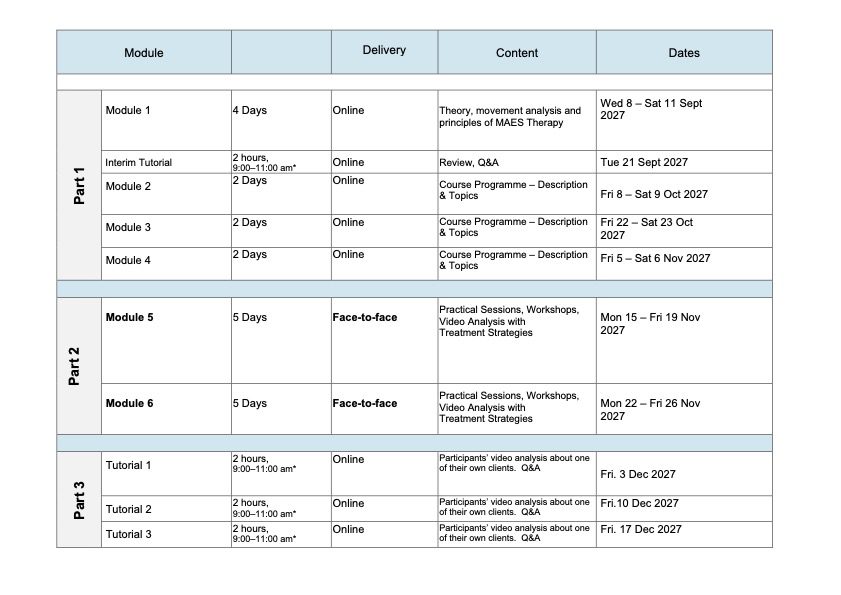
*Tutorial times are subject to confirmation
Venue:
Location for Face-to-Face Modules 5 and 6 :- Greater Manchester – location to be advised
Course Presented by:
Jean-Pierre Maes MCSP Consultant Neurodevelopmental Physiotherapist,
Founder & Director M.A.E.S. Therapy International
with members of the M.A.E.S. International Team
Jean-Pierre is an acknowledged expert in the field of Cerebral Palsy and similar neuro-developmental conditions, with over 35 years’ experience of treating babies, children and adults.
He was a Senior NDT- Bobath Tutor – one of the most experienced and influential international Senior Tutors and regular Course Leaders.
However, Jean-Pierre wanted to progress and improve the treatment of children further and so he decided to leave NDT-Bobath and now practices and teaches the innovative M.A.E.S. Therapy Approach.
Due to demand, he now leads M.A.E.S. Courses world-wide, teaching the advanced MAES Therapy Approach for paediatric therapists who want to specialise, or to further specialise, in the treatment of children with CP and similar neurodevelopmental conditions and who want to gain deeper knowledge and expert clinical skills to improve the outcomes for their patients.
___________________________________________________________________________
Course Fee:
Early Bird Discount: £ 3,390.00 Saving £400 When paid in full by 1st June 2027
Saving £400 when the full early-bird payment requirements are met.
Regular Course Fee: £ 3,790.00 GBP
5% Discount per participant is available when two or more colleagues from the same workplace apply and register together.
A deposit of £500 is required to secure your place.
The deposit is normally non-refundable. However, it may be refunded if a suitable* replacement participant is accepted onto the course and pays the required deposit.
Suitable, i.e. meets the Course Participants’ Criteria.
M.A.E.S. Therapy International Ltd is not registered for VAT.
No VAT will therefore be added to the published course fee.
___________________________________________________________________________
Course Aims:
This course aims to:
-
- Provide a ‘Framework’ for an effective assessment and better understanding of the challenges and needs of children with Cerebral Palsy (CP) and similar neurodevelopmental conditions
-
- Gain expertise in analysis of coordination and effective and structured clinical reasoning skills.
-
- Analyse Tasks in term of fine and gross motor, sensory, perceptual, biomechanical and cognitive components.
-
- Relate the quality of execution of given tasks to the specific skills that the child has been able to develop and use to accomplish these tasks.
-
- Predict motor behaviour (prognosis) based upon an in-depth analysis of typical presentations associated to spastic hypertonia, dyskinetic CP, ataxia, hypotonia and CP associated with preterm birth.
-
- Understand the short and long-term consequences for the child to engage in complex activities, when the skills available are missing and consequently for therapists to establish priorities and short and long-term treatment plans to change the child’s natural course of development.
-
- Develop high-level problem-solving skills to provide each child with specific sensory-motor experiences to make best use of their own potential for improvement.
-
- Prioritise and identify which specific skills a child is missing and that need to be promoted and at the same time discouraging the compensatory strategies this child is over-relying upon and which prevents the development of more advanced skills.
-
- Expand creative thinking and develop an extensive repertoire of treatment strategies and skills, which can then be applied more confidently in a range of situations to enable the child to learn new ways that he would have difficulty or not be able to develop on his own.
-
- Effectively inform and guide parents during treatment sessions, including the use of toys for play and advise them how to best interact with their child during activities of daily living in a home environment.
Course Participant Criteria:
Applicants must be fully qualified paediatric physiotherapists, occupational therapists, speech and language therapists, paediatricians or neurologists, and should normally have at least two years’ experience of working with children with cerebral palsy or similar neurodevelopmental conditions.
The course is suitable both for therapists undertaking their first specialist postgraduate cerebral palsy physiotherapy course in the field of cerebral palsy and for highly experienced clinicians who have previously completed specialist training.
M.A.E.S. Therapy introduces a distinctive framework for movement analysis, clinical reasoning and treatment. Participants should therefore be open to examining familiar clinical presentations from a different perspective.
Course Format:
Presented at post-graduate level, this certified CP paediatrics course is very ‘hands-on’. The format will include theoretical lectures, treatment demonstrations, workshops, case presentations and supervised daily practical sessions with patients during Modules 5 and 6.
Unique of its kind, this neurodevelopmental course has a strong emphasis on high-level observation, analysis and clinical skills based on new knowledge gained.. There is an unusually high level of supervised practical sessions (almost 50% of time), with a wide variety of case presentations, giving depth and breadth to the learning experience.
The course is specially designed to give participants time to translate theory into clinical practice and become expert in handling and managing their clients with neuro-developmental conditions.
Development of clinical skills:
In addition to the Topics, throughout Part 2 Therapists will also have:
10 Supervised Practical Sessions
During Part 2, participants will work with a variety of children presenting with different forms and features of Cerebral Palsy. Participants usually work in pairs, and occasionally in groups of three, with one child at a time.
10-15 Treatment Workshops based on participants’ live case presentations.
Participants will have opportunities to observe, analyse and contribute to the treatment of approximately 15–20 children with different presentations of Cerebral Palsy. This breadth of supervised clinical experience enables participants to translate theory into practice and develop advanced handling and problem-solving skills based on the new insights and principles introduced during the course.
NHS & M.A.E.S. Therapy
MAES Therapy works with over 35 NHS Trusts around the UK who have invited Over 35 NHS Trusts around the UK have invited M.A.E.S. Therapy to provide either highly specialised ‘In-Service’ training for their therapists (PT, OT, SLT), or have sent Therapists from their Trust to attend MAES Therapy Training Courses to gain deeper knowledge and improved clinical analysis and clinical skills for treating babies and children with Cerebral Palsy and similar neuro-developmental conditions and movement disorders.
M.A.E.S. Therapy is an innovative evidence-based approach, underpinned by practice evidence, patient evidence and contextual evidence from 35 years’ expert clinical and teaching experience world-wide and focusing on excellent treatment skills.
M.A.E.S. ‘ Movement Analysis & Education Strategies’ Therapy
Paediatrics
Neurology
#maestherapy #cerebralpalsy #CP #neurodevelopmentaldisorders #preterm #developmental delay #prematurity #neurodevelopment #ChildDevelopment#neurodevelopmental conditions #spasticity #hie #periventricularleukomalacia #pvl #movementdisorder #earlyintervention #paediatric #pediatric #childphysiotherapy #toewalking #prematurity #CPchild #cerebralpalsykids #evidencebasedpractice #CPplateau #plateau #clinicalexcellence #Physiotherapy #OccupationalTherapy #SpeechTherapy
M.A.E.S. Therapy is the new gold standard for treating children with Cerebral Palsy and similar neuro-developmental conditions and movement disorders; with more effective long-term outcomes compared to other therapeutic approaches such as Bobath-NDT, Vojta, Medek, ABM, EI Smart.
